
Charlotte Criminal History Checks
Begin with the office that made the record. Charlotte Police holds city incident and arrest narratives. Eaton County Jail can confirm a recent county booking, while 56A District Court carries misdemeanors and the first stages of felony cases. If a felony is bound over, its later file moves to 56th Circuit Court. Michigan State Police then provides a separate statewide public history through ICHAT. None of those products replaces the rest.
A practical Charlotte record check follows the event from local report to final court action:
- Ask Charlotte Police for the incident or arrest report by report number, date, place, and involved role.
- Call Eaton County Jail at 517-543-3512 when a very recent Charlotte arrest may have led to county custody.
- Search the Eaton County Public Case Search, starting with 56A District Court.
- Check 56th Circuit Court if a felony was bound over, and order missing documents from the clerk.
- Use ICHAT for reportable public history from across Michigan, not for warrants or a city police narrative.
Match names with care. A similar name alone does not show that two entries concern the same person, and an arrest charge may not match the charge later filed in court.
Charlotte Police and Court Records Differ
A common Charlotte search error is asking the city for a court judgment or asking Eaton County for a Charlotte Police narrative. The city owns the reports its officers create. The state trial courts hold pleadings, hearings, orders, dispositions, and sentence records. Eaton County Jail holds the booking episode. These offices sit close to one another, but their files do not merge into one public database.
That split can help narrow a request. Use the police report for what officers documented at the scene. Use a booking record for custody facts, charge entries, bond, and release. Use the court file to learn what the prosecutor filed and what the judge decided. The broader Eaton County criminal history overview explains the county and state layers without turning the Charlotte inquiry into a county-wide search.
Records at Charlotte Police Department
The Charlotte Police Department offices page lists the department at 111 East Lawrence Avenue, Charlotte, MI 48813. The business number is 517-543-1552, the fax is 517-543-8396, and the nonemergency number is 517-541-0767. Ask the city for police-created incident reports, arrest reports, statements, and releasable photos. Include the report number when known because it gives staff a direct key to the file.
The official police offices image below comes from that city source.
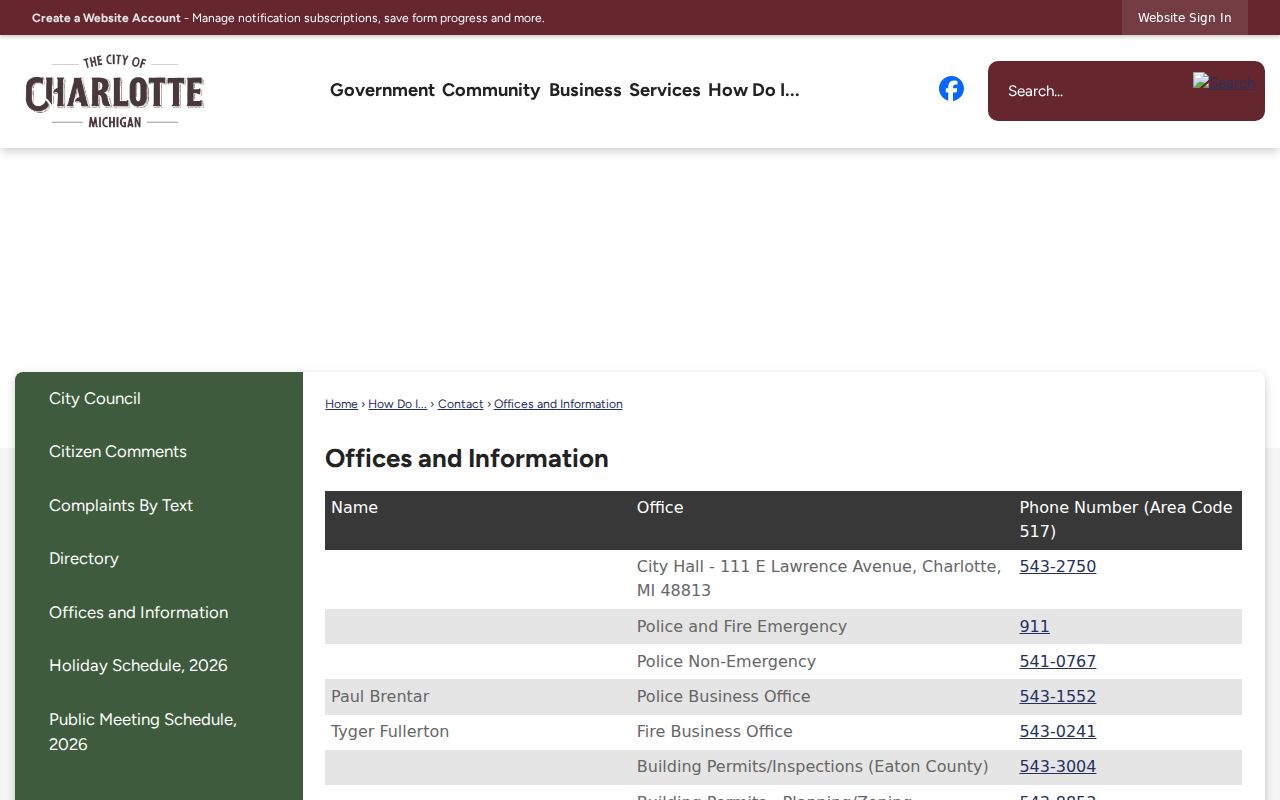
It points searchers to the city office that holds Charlotte police records, rather than to a county clerk that did not create them.
Charlotte also publishes a police-only request form. It allows either a copy or inspection request and offers choices for an incident report, photos on digital media, statements, or another described record. The requester supplies contact details, signs, and dates the form. A precise request can reduce the time spent identifying the correct incident.
Charlotte Police FOIA Choices
The Charlotte FOIA channel accepts written requests through the city clerk. Requests may go by email to foia@charlottemi.org, by mail or hand delivery to 111 East Lawrence Avenue, or by fax to 517-543-8851. The city normally responds within five business days and may take one ten-business-day extension. That response may grant the request, deny it under a cited exemption, seek clarification, or estimate lawful costs.
The city route differs from Eaton County FOIA. A Charlotte Police report stays with Charlotte even when the arrest later results in an Eaton Jail booking or Eaton court case. Police files can also need review for active-investigation details, protected victim material, juvenile information, and personal identifiers. A redaction does not mean the full file vanished; it means the released copy omits material the city determined was not public.
Note: Ask for an existing record, not a new explanation or analysis of what the record means.
Booking and Arrest Records in Charlotte
Charlotte Police creates the arrest report, but a person taken into county custody is normally booked at Eaton County Jail, 1025 Independence Boulevard in Charlotte. Booking creates a distinct file with the booking time, arresting agency, charge entries, bond or hold, court reference, custody status, and release information. Medical screening, security classification, victim data, and other protected material are not ordinary public profile fields.
Eaton County does not publish a clearly official live jail roster on its own site. For a recent Charlotte arrest, call the jail at 517-543-3512, then search 56A District Court for arraignment activity. Request the arrest narrative from Charlotte Police and releasable booking material from the county. Unofficial roster sites are a poor substitute because their age, scope, and source can be unclear.
A booking charge is a snapshot. The prosecutor may file a different charge, amend it, or decline it. The final Charlotte criminal case result comes from the court judgment, not the first jail entry.
Charlotte Criminal Record Counters
Charlotte is both the county seat and the city where Eaton's main justice offices sit. The jail and sheriff are at 1025 Independence Boulevard. The 56A District and 56th Circuit courts are at 1045 Independence Boulevard. That short physical gap can hide an important records gap: the sheriff counter handles sheriff and jail material, while the court clerks handle filed cases and court copies.
Eaton Sheriff Records and Jail
1025 Independence Boulevard
Charlotte, MI 48813
Records: 517-543-5247
Jail: 517-543-3512
Eaton Trial Courts
1045 Independence Boulevard
Charlotte, MI 48813
Circuit: 517-543-4335
District Criminal: 517-543-4029
The Sheriff Records lobby also has an after-hours drop box. It can help with a written county request when the weekday counter is closed, but it does not convert a sheriff request into a Charlotte Police or court request.
The Charlotte Municipal Court File
Charlotte does not operate a separate public criminal municipal court. Adult city cases enter Michigan's state trial-court system. Misdemeanors and early felony proceedings appear in 56A District Court. A felony moves to 56th Circuit Court after a waiver or probable-cause finding and bindover. Searchers should not wait for a nonexistent Charlotte court portal.
| Court Name | 56A District Court and 56th Circuit Court |
|---|---|
| Case Types Heard | District hears misdemeanors and felony preliminary stages; Circuit hears bound-over felonies and high-court misdemeanors |
| Case Lookup Channel | Eaton Public Case Search by name or case number; clerk counter and copy request for missing documents |
| What the Docket Shows | Case number, court, party, charge, events, hearings, plea, disposition, sentence, and financial entries when public |
| Copies & Fees | $2 per page; certified copy $10 for the first page plus $1 for each added page; filed transcripts $0.30 per page |
Online register entries may not include every pleading. Give the clerk the full case number, party name, court, and exact document needed.
Charlotte Court Records Through Time
Charlotte's role as county seat gives its records story a longer local frame. Eaton County government first operated in Bellevue because early Charlotte lacked the people and buildings needed for county business. Charlotte became the working seat around 1840, and court was once held in the Eagle Hotel. Later courthouses carried the work before the modern complex opened.
Historic setting does not change today's custodian rules. Old case series and archival material may need a clerk or archive inquiry, while a recent city police incident still belongs with Charlotte. Eaton's first Circuit judgments date to 1847, and its Circuit criminal series dates to 1859. A genealogy or historical search should state the year range and record type, rather than using only a name and expecting the current web search to cover all eras.
How Charlotte Records Reach the County
A Charlotte incident can create several records at different points. Police write the incident or arrest report. Eaton Jail creates a booking file if custody follows. The prosecutor reviews possible charges. District Court opens the first criminal case record, and Circuit Court takes a felony only after bindover. Courts and agencies then report qualifying arrest and disposition data to the Michigan State Police Criminal Justice Information Center.
Record flow: Charlotte Police Department › Eaton County Jail and Trial Courts › Michigan State Police CJIC
Timing explains many mismatches. A fresh police report can exist before the public court register appears. The booking charge can differ from the prosecutor's complaint. ICHAT can lag until reportable data reaches the repository, and it omits warrants, traffic, juvenile, federal, tribal, other-state, and nonreportable local misdemeanor material. Compare the sources instead of forcing them to match on the same day.
Missing Charlotte Court Record Documents
MiCOURT and the Eaton launch page can show a register of actions without making every filing downloadable. When a Charlotte criminal record appears but the needed complaint, order, or judgment does not, note the full case number and court. Call District Criminal at 517-543-4029 or the Circuit Clerk at 517-543-4335. Then use the Court Record/Copy Request for a specific document or complete public file.
Copy cost affects broad requests. Eaton posts $2 per page, $10 for the first certified page plus $1 for each additional page, $1 for forms, and $0.30 per page for filed transcripts. Ask for an estimate before ordering a full case. Inspection may be a better first step when the file is large or the exact useful document is not known.
Note: A missing online image is not proof that the filed document is sealed or destroyed.
Charlotte Record Access Rules
Michigan law draws different paths for city police records, court records, and statewide criminal-history data. Charlotte responds to requests for its existing nonexempt records under FOIA. The trial-court clerks use Michigan Court Rule 8.119 for court-file maintenance and access. MSP disseminates its public criminal-history product under a separate statute. Juvenile files, protected victim details, personal identifiers, sealed material, and set-aside convictions can be restricted.
Key Statutes:
Michigan Freedom of Information Act, MCL 15.231 et seq. creates a right to request nonexempt records held by covered public bodies.
MCL 15.243 lists exemptions that may support redaction or withholding after review.
Michigan Court Rule 8.119 governs court-record access and nonpublic treatment.
MCL 28.241a governs public criminal-history dissemination by MSP.
Describe the record, date range, location, report or case number, and preferred format. That helps Charlotte staff locate an existing file without asking them to create a new explanation.
Charlotte Criminal Records by Place
Official county planning data placed Charlotte at 9,069 residents in its February 2023 profile. The population figure establishes why Charlotte is one of Eaton County's three city guides, but it does not supply a crime rate. For crime data, use the Michigan Incident Crime Reporting dashboard and record the exact year, city, agency, offense, and extraction date selected.
The Census QuickFacts source for Charlotte supplies a separate official view of the city.
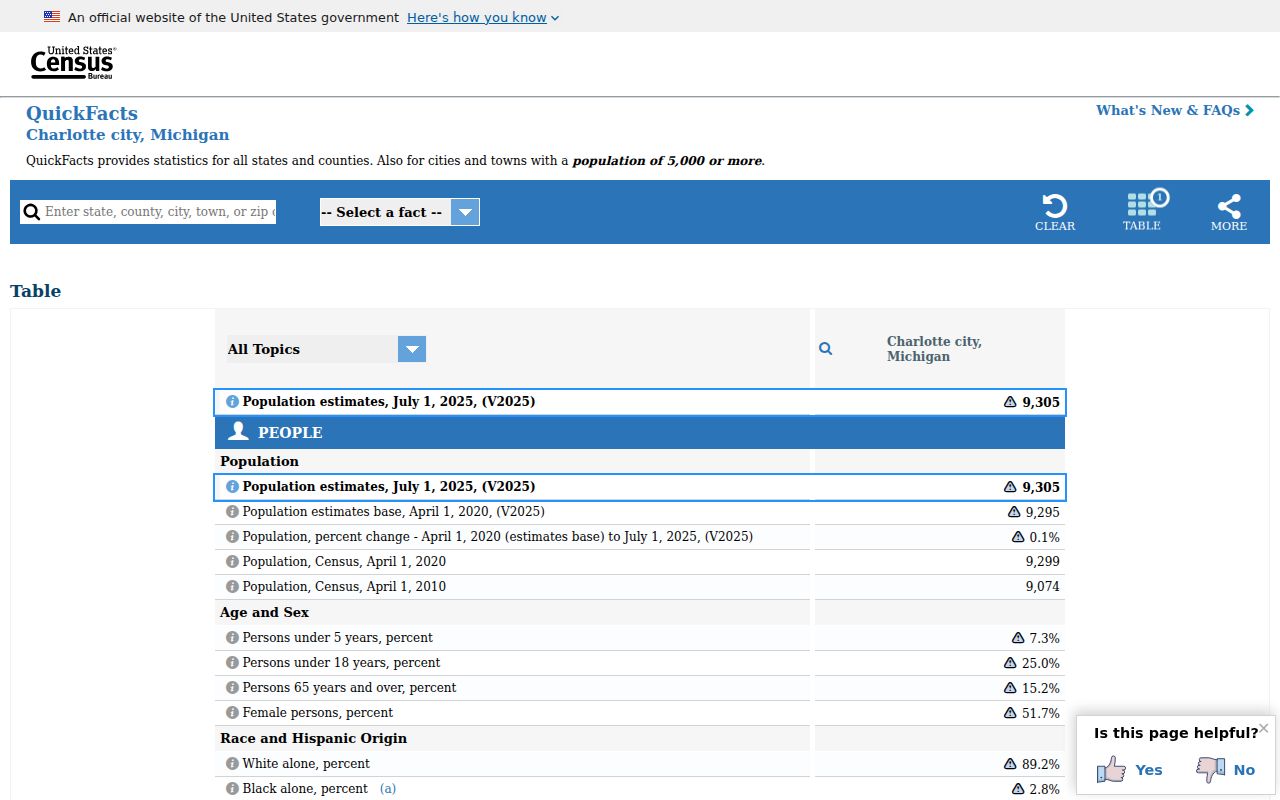
The image anchors the record discussion to Charlotte itself while the police, jail, and court sources explain which office actually holds each criminal record.
Dashboard totals can differ when a table groups incidents by reporting agency rather than the actual city code. A careful Charlotte comparison names the filter, not just the number. Without a saved table and date, a precise offense count can sound more certain than the source permits.