
Criminal Court Cases in Eaton County
Eaton County uses two trial courts for the main criminal path. The 56A District Court handles adult misdemeanors punishable by up to one year. It also handles the first steps in felony matters: arraignment, the probable-cause conference, and the preliminary examination. If a felony is bound over, the 56th Circuit Court becomes the trial court. A searcher should therefore check District Court first when following a new felony, then use the Circuit number after transfer.
Both courts sit at 1045 Independence Boulevard in Charlotte, but each clerk keeps its own docket. The Circuit Clerk can be reached at 517-543-4335. District Court’s main number is 517-543-7520, and its criminal line is 517-543-4029. Public hours for the two courts are 8:30 a.m. to noon and 1:00 to 4:30 p.m. A clerk can identify the right file, explain copy procedures, and confirm whether a requested item is public. The clerk cannot reinterpret the judgment or change a court order.
Eaton Felony Court Search Split
A single Eaton County felony prosecution may produce both a District Court case number and a Circuit Court case number. That does not mean two unrelated criminal cases exist. District entries document the complaint, arraignment, bond, probable-cause conference, and preliminary examination. Circuit entries begin after bindover and follow the information, motions, plea or trial, judgment, sentence, and later activity.
Start at the county’s Public Case Search launch page, which separates Circuit and District searches. A recent arrest may appear only in District Court at first. If the docket says the case was bound over, use the related Circuit number for the final outcome. For a misdemeanor, District Court is usually the complete court trail. This split is one reason an ICHAT result cannot replace the Eaton judgment.
The official Eaton search page is shown in the county’s case-search source.
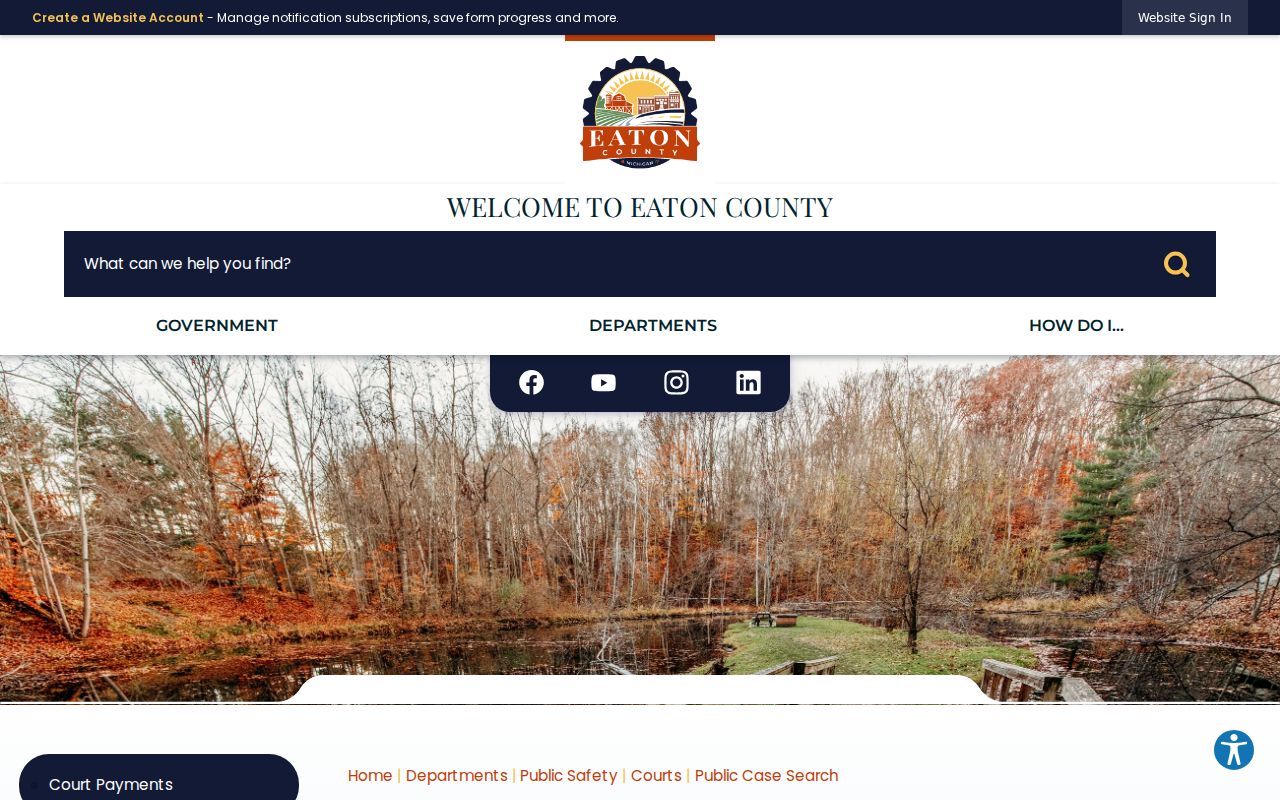
Its separate court links help a reader choose the right docket before searching by name or number.
Eaton County Case Record Searches
MiCOURT Case Search provides free access to participating Michigan trial-court dockets, including direct Eaton searches for District and Circuit Court. It is an index and register of actions, not a promise that every pleading is downloadable. Use a complete case number when known. A name search works best with the last name, first name, and date of birth needed to distinguish people with similar names.
- Open Eaton County’s launch page and select 56A District Court or 56th Circuit Court.
- Accept the terms, then choose a name search or a case-number search.
- Enter the full number, or narrow a name with first name and date of birth.
- Read the court, status, charge, event, plea, disposition, sentence, and balance fields in context.
- Ask the correct clerk for a register of actions, a specific pleading, a transcript, or a certified copy.
| Field | Type | Required | Use |
|---|---|---|---|
| Search by Name / Case Number | Tabs | Yes | Select one search mode |
| Last Name / Business Name | Text | Conditional | Main name-search field |
| First Name | Text | Optional | Narrows name results |
| Date of Birth | Date | Optional | Helps distinguish a person |
| Case Category | Selector | Optional | Filters the current result set |
| Case Number | Text | Conditional | Use the full formatted number |
Note: MiCOURT covers participating courts and public fields; an empty result does not prove that no restricted, older, or differently indexed file exists.
Order Eaton Court Case Copies
When the online docket does not display the needed document, submit Eaton County’s Court Record Copy Form Request. The form asks which court holds the record, the request date, requester contact details, complete case number, and party names. It lets the requester choose review, copies, a register of actions, a complete public file, a named court record, or a filed transcript. A complete-file order should be estimated first because page charges add up.
| Item | Posted charge |
|---|---|
| Ordinary copies | $2 per page |
| Certified copy | $10 first page, plus $1 each added page |
| Forms | $1 each |
| Filed transcripts | $0.30 per page |
Eaton Trial Courts
1045 Independence Boulevard
Charlotte, MI 48813
Circuit: 517-543-4335
District Criminal: 517-543-4029
Public hours: 8:30 a.m.-noon and 1:00-4:30 p.m.
What a Criminal Case File Contains
The Eaton County register of actions is a timeline, while the case file contains the records behind that timeline. Search results may show the judge, parties, attorney, charge level, scheduled hearings, bond actions, plea, disposition, sentence, and financial balance. The complaint usually begins a District case. After bindover, the prosecutor’s information becomes the formal Circuit charging document. Compare those documents when an arrest charge and final charge differ.
| Case number and court | Identifies the correct District or Circuit file and its jurisdiction. |
|---|---|
| Charging document | Shows the filed allegation, statute, and counts at that stage. |
| Register of actions | Lists filed events, hearings, orders, and case status by date. |
| Hearing details | Shows scheduled event type, date, time, and later result when entered. |
| Disposition and judgment | States whether a count ended in plea, verdict, dismissal, or acquittal. |
| Sentence and conditions | Records the ordered custody, probation, fines, costs, restitution, and related terms. |
Public display varies by record. Birth dates, Social Security numbers, protected victim or minor information, sealed material, and other personal identifiers are not ordinary public fields.
Read Eaton Criminal Court Outcomes
Docket words describe different legal events. They should not be blended into a single “criminal result.” A dismissal ends a charge without a conviction on that charge. An acquittal is a not-guilty verdict. A plea may resolve an amended offense, so the conviction can differ from the allegation stated at arrest.
- Arraignment
- The hearing where charges are stated and plea and bond matters are addressed.
- Bindover
- Transfer of a felony from District Court to Circuit Court after waiver or a probable-cause finding.
- Disposition
- The final recorded outcome of a charge or case.
- Information
- The prosecutor’s formal charging document in Circuit Court.
- Sentence
- The court-ordered consequence entered after conviction.
Read the event next to its date and count. A plea entry alone does not supply every sentence term, and a scheduled hearing does not prove it occurred as planned.
Criminal Case Stages in Eaton County
An Eaton County case can begin by arrest or summons. District Court then conducts arraignment. For a felony, the probable-cause conference and preliminary examination test whether the matter will move forward. Bindover sends it to Circuit Court, where an information, a new arraignment, motions, and pretrial events follow. The case ends through dismissal, plea, or trial, then judgment and sentence if there is a conviction. Appeals and postjudgment motions can create later entries.
Case flow: Charges Filed → Arraignment → Pretrial → Plea or Trial → Disposition → Sentencing
The 56A District Court source shows the local court that handles the opening stages.
That court-to-court path explains why one Eaton prosecution can have two connected case numbers.
Eaton Criminal Court Program Entries
Local problem-solving programs can add distinct docket events and supervision orders. Eaton County identifies Adult Circuit Drug Court, Swift & Sure, Felony Sobriety programming, and the J. Sauter Veterans Treatment Court. The veterans court began in fall 2013 for qualifying nonviolent veterans with substance-use or mental-health needs. Program participation is not a separate verdict. It must be read with the plea, judgment, sentence, and any later discharge or violation order.
The docket may use a program name without explaining all eligibility terms or services. Obtain the signed order when the exact duty matters. A supervision entry also should not be mistaken for a new charge. Michigan’s trial court directory supplies the broader court structure.
The official Michigan trial-court source places Eaton’s courts in that statewide framework.
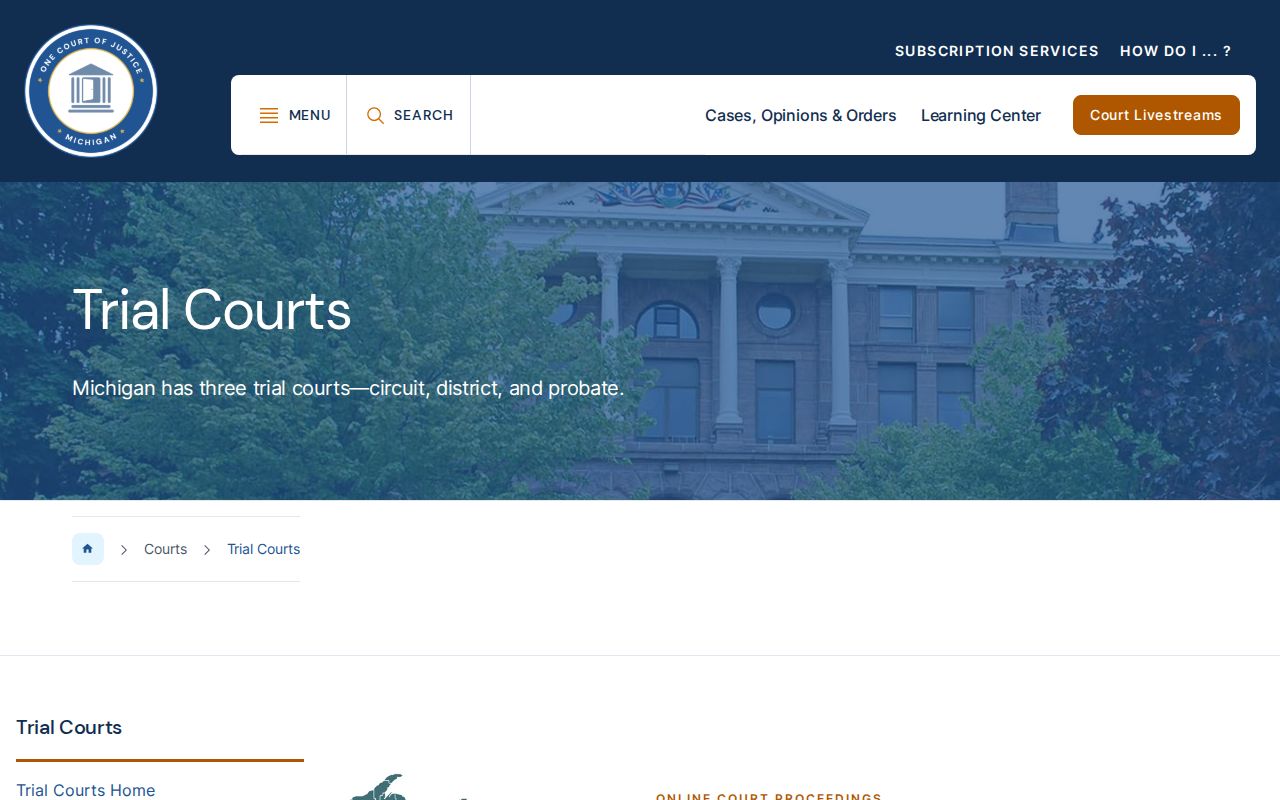
It is useful when a name search points to a court outside Eaton or the venue is uncertain.
Access Rules for Case Records
Michigan Court Rule 8.119 governs court-record maintenance, access, and nonpublic treatment. Court files follow clerk and court-rule procedures, not the same route as a Sheriff incident-report request under FOIA. A public docket can omit sealed documents, protected identifiers, juvenile material, victim information, and other records made nonpublic by law or order.
If an Eaton County court case does not appear, confirm spelling, birth date, court, and both possible case numbers. Then ask the clerk whether the file exists and which parts are available for inspection or copy. A clerk may provide a public record or explain a restriction, but cannot create a new analysis. Michigan set-aside orders make qualifying conviction records nonpublic under MCL 780.623.
Eaton Court Cases Versus ICHAT
MiCOURT and the clerk organize information by case. ICHAT organizes public criminal-history information held by Michigan State Police across reportable Michigan events. An Eaton court file can show pleadings, motions, hearing entries, bond actions, financials, and the signed judgment that ICHAT does not reproduce. ICHAT may connect reportable records from more than one Michigan county, but it omits warrants, federal and tribal history, traffic matters, juvenile and suppressed records, and other categories outside the public product.
For a precise Eaton outcome, use the court judgment. For broader statewide public history, compare it with ICHAT. A missing or unmatched disposition may reflect reporting lag rather than an open case. The arresting-agency report and jail booking can add another layer, but neither proves conviction. The separate Eaton County arrest search explains that earlier custody trail.
Note: Compare records by case number, tracking number, charge, and date before treating two entries as the same event.