
Eaton County Sex Offender Checks
The Michigan State Police manages the public Michigan Public Sex Offender Registry, or PSOR, under the Sex Offenders Registration Act. Eaton County results can be found by selecting the county, entering an address, searching a name, or using the neighborhood map. The public website is a subset of the law-enforcement registry. It does not expose every record held by police.
Begin with the search mode that matches what is known. A name search requires both first and last names, but partial names are accepted. A registration number or MDOC number can identify a record more directly. For community awareness, the Eaton County filter or address-and-radius map is often more useful than a broad name query.
Map Eaton County Registry Results
The neighborhood search accepts street, city, ZIP, and county fields, then applies a radius. Michigan offers quarter-mile, half-mile, one-mile, two-mile, and five-mile choices. A mapped result depends on the quality of the registered address and geocoding. The “Map Offender” control on an individual profile may be unavailable when an address cannot be plotted.
The official PSOR search source shows Eaton County’s name, place, identifier, and map options.
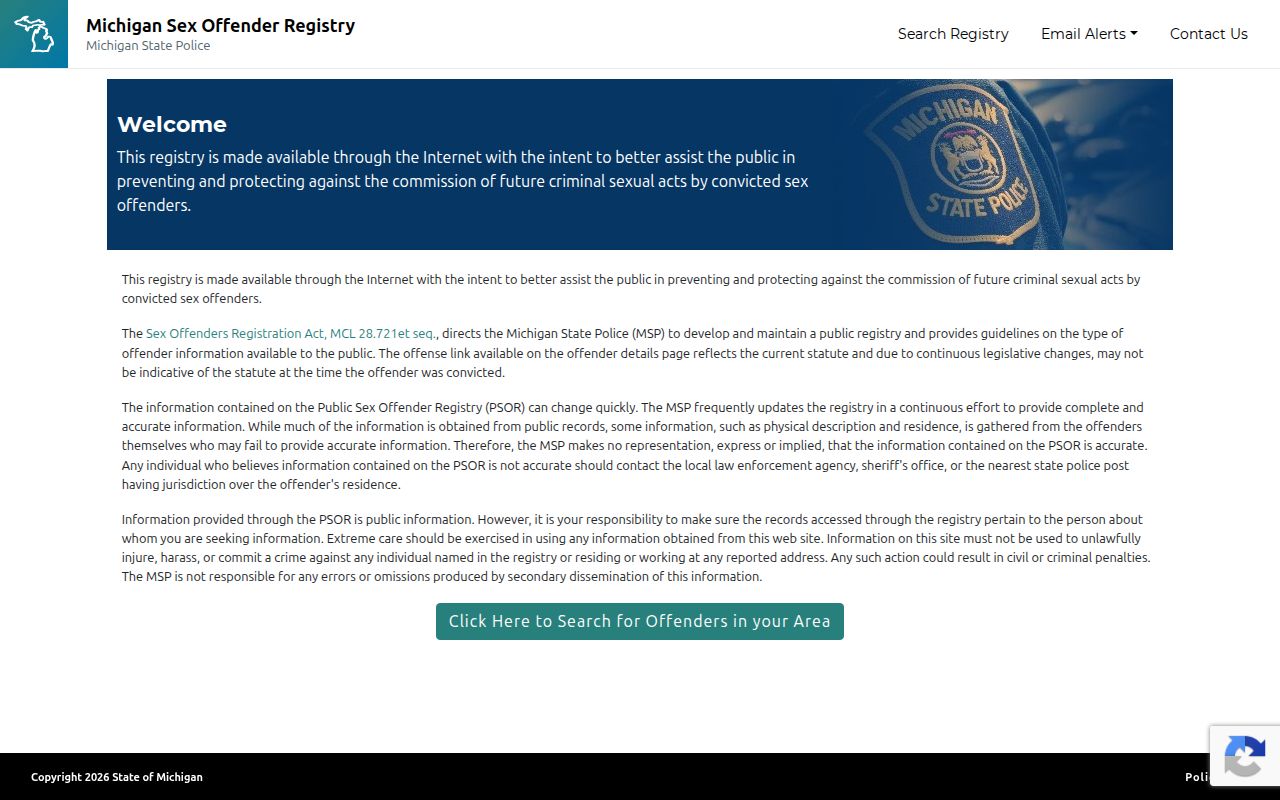
These tools support either a county-wide scan or a smaller area around a known address without using an unofficial map.
Michigan Public Sex Offender Registry Searches
PSOR is free, though Michigan State Police warns that heavy traffic can make it temporarily unavailable. Search with enough detail to avoid a false match, then read the full profile rather than relying on a result card. Status, address history, registration detail, and offense fields add context that a name alone cannot supply.
- Open PSOR and choose name, identifier, location, neighborhood map, or a published-offender list.
- For a name, enter first and last names. For place, select Eaton County and add city, ZIP, address, or radius as needed.
- Review possible results using the public photograph, aliases, date of birth, and registration number.
- Open the profile and read offense, address, vehicle, status, map, and registration fields together.
| Field | Type | Required | Official use |
|---|---|---|---|
| First and Last Name | Text | Both for name mode | Partial names accepted |
| Registration / MDOC Number | Text | Conditional | Identifier search |
| Street Address | Text | Conditional | Pair with city, county, or ZIP |
| City / County / ZIP | Text or select | Optional | Select Eaton for county results |
| Neighborhood Map | Map fields | One or more | Street, city, ZIP, or county |
| Radius | Select | For radial search | 0.25, 0.50, 1, 2, or 5 miles |
Note: PSOR also links to all published, incarcerated, and non-compliant offender result sets; those are statewide lists, not Eaton-only counts.
Some Eaton Convictions Stay Unlisted
A person not found in the public registry may still have historical justice-system records. Michigan’s official FAQ lists several reasons a person may not appear: juvenile adjudication, death or nonresidency, a nonlisted offense, some pre-October 1995 situations, judicial removal, a qualifying set-aside, HYTA participation, completed registration duration, or a law that keeps the offense from public display. The absence of a PSOR result is therefore not proof that no past conviction exists.
PSOR also never publishes victim information. Its public fields are chosen by statute and policy, while law enforcement keeps a broader registration database. For questions about an Eaton registration that a public search cannot resolve, contact the local sheriff or the statewide registry program rather than guessing from a blank result.
A set-aside can matter to publication, but it should not be inferred from silence in a result list. The same is true for completed duration and judicial removal. If reviewing one’s own record, compare the court order with current PSOR and ask the maintaining agency about a mismatch. For community searches, treat the registry as a current public-safety tool with legal limits, not as a complete archive of every old Michigan case.
Registry Profiles: What They Show
An Eaton County registry profile brings together identity, offense, place, and compliance fields. Match more than one identifier. Similar names, an old address, or a partial search can otherwise lead to the wrong conclusion. Registration status is separate from the offense and tier. It describes the record’s current administrative state.
| Name and aliases | Published identity names tied to the registration record. |
|---|---|
| Photo and descriptors | Photograph, date of birth, scars, marks, tattoos, and other public traits. |
| Registration identifiers | Registration number, details, and MDOC linkage where shown. |
| Offense information | Listed offense facts supporting the registration duty. |
| Address and campus | Published home, school, and campus information where applicable. |
| Work and vehicle fields | Registered work data and vehicle information shown by PSOR. |
| Status | Active, incarcerated, out-of-state, absconder, homeless, school-only, or work-only labels. |
The details page can offer “Map Offender” and “Track Offender.” Individual pages may be printed, but the full registry cannot be downloaded in bulk.
Read Eaton Registry Status Labels
Status terms prevent a common error: treating every public profile as a person currently living at a fixed Eaton address. “Incarcerated” points to custody. “Pending Out of State” and “Inactive Out of State” describe interstate record conditions. “Absconder” and “Homeless” carry different meanings. “School Only” and “Employment Only” identify why a Michigan registration link remains.
- Active
- The record remains active under Michigan registration administration.
- Absconder
- The person is recorded as failing to maintain required contact or location reporting.
- Homeless
- The record does not list a conventional fixed residence.
- Out of State
- The profile reflects a move or pending move outside Michigan under the shown status.
Noncompliance labels may refer to a form, ID, immigration document, professional-license data field, telephone, or vehicle requirement. Report a concern to police. Do not attempt personal verification.
Registration Levels and Duties in Michigan
Michigan assigns Tier I, Tier II, and Tier III duties. The tier affects the general duration and how often verification occurs. Tier I generally verifies annually, Tier II semiannually, and Tier III quarterly. A registrant must also report specified changes within three business days. Statutory exceptions and orders can affect a particular record, so the public profile and current law control.
| Tier | General duration | General verification |
|---|---|---|
| Tier I | 15 years | Annual, generally in birth month |
| Tier II | 25 years | Semiannual, in paired months |
| Tier III | Life | Quarterly, in one of three month cycles |
The statute also sets a one-time $50 initial registration fee and a $50 annual fee thereafter, capped at $550. Those charges concern registration duties, not public PSOR use.
Verification months follow the birth month. Annual verification occurs in that month. Semiannual reporting uses paired months six months apart. Quarterly reporting uses one of three cycles: January, April, July, and October; February, May, August, and November; or March, June, September, and December. The tier table gives the general rule, while a profile, order, or statutory exception may affect an individual duty. A reader should not calculate compliance from the calendar alone.
Track Eaton Registry Profile Changes
The “Track Offender” control provides email enrollment for an individual profile. Enter the same email address twice, agree to the Terms of Use, and select Register. Michigan says confirmation should arrive within 24 hours. Later alerts can cover moves and changes to registered work or school information. This feature follows a selected profile rather than every address in Eaton County.
The Michigan State Police registry help source explains public fields, statuses, reporting, and tracking.
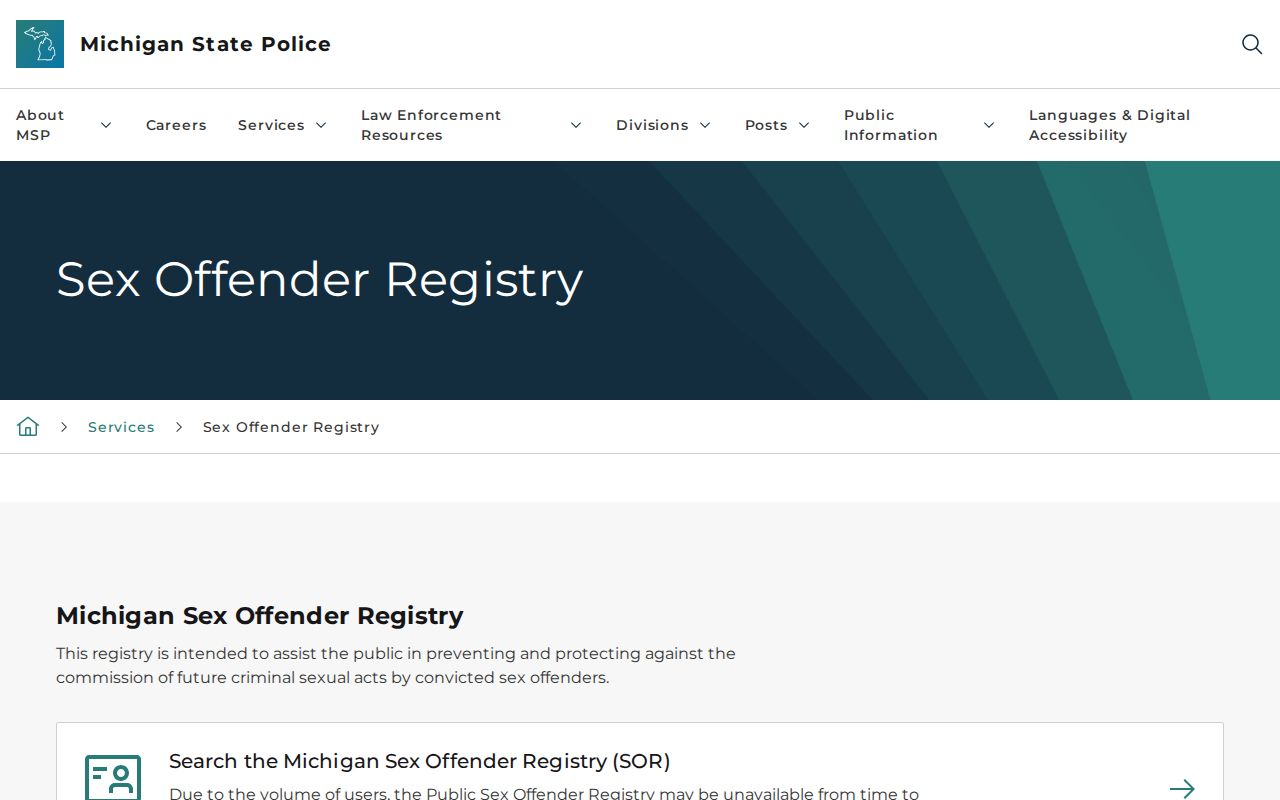
Use the current help page when a profile control or status is unclear because registry features and legal duties can change.
Email tracking is useful for a known profile, but it is not a substitute for a fresh Eaton County map search. A move into the area, an address that cannot be geocoded, or a newly published profile may call for a new place-based query. Keep the confirmation message and follow the official link in an alert. If no confirmation arrives within the stated window, return to the profile and check the entered address instead of assuming tracking is active.
Cross-State Eaton Offender Searches
PSOR is the primary Michigan source. The U.S. Department of Justice’s National Sex Offender Public Website adds a cross-state layer when a search may extend beyond Michigan. It searches participating public registries, so results still reflect what each jurisdiction lawfully publishes. A national no-result response does not overcome Michigan’s publication limits or prove that no record exists.
The official NSOPW source shows the national search entry point.
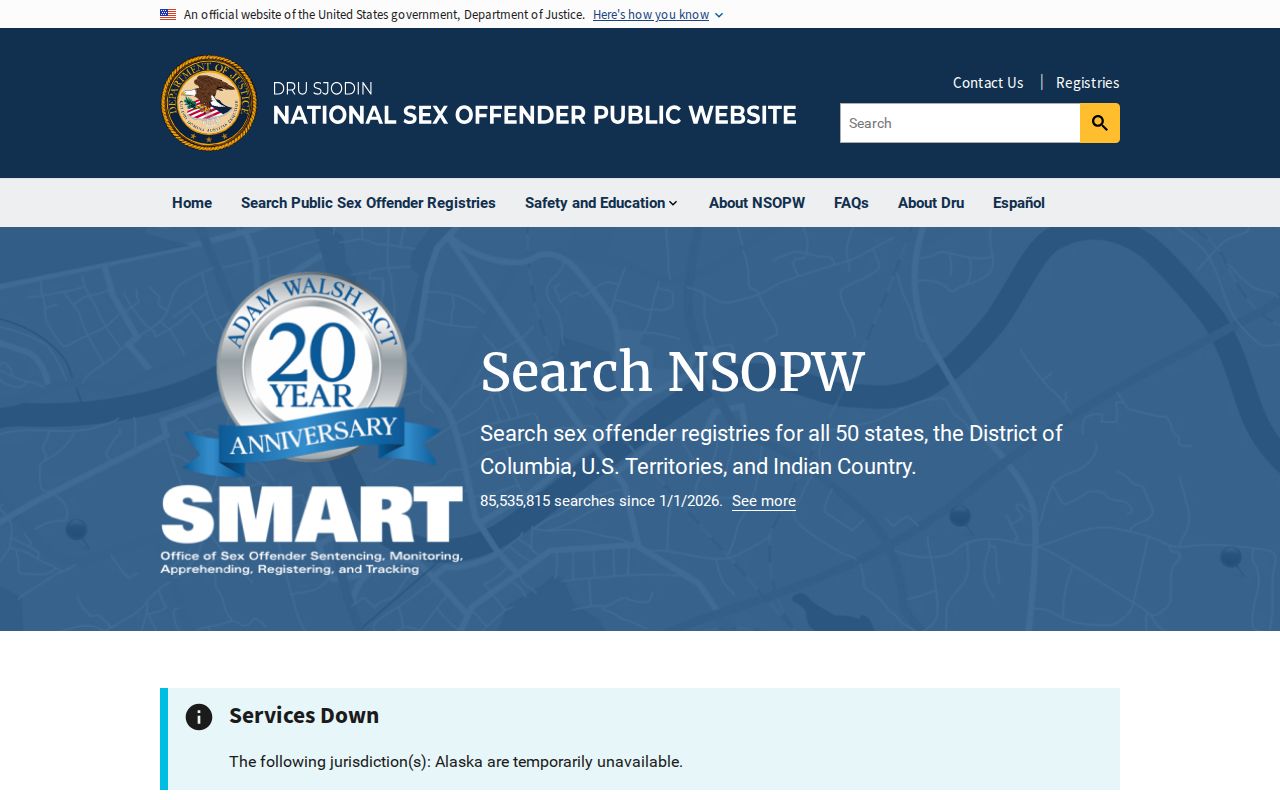
Use NSOPW when a move, alias, or known event crosses a state line, then return to the originating state profile for detail.
Using Registry Information Lawfully
Registry information supports awareness and practical safety planning. It does not authorize threats, harassment, intimidation, discrimination, or vigilantism. If an Eaton County profile appears noncompliant or an address seems wrong, preserve the public record details and contact law enforcement. Do not visit the address or confront the person. Eaton questions may go to the Sheriff or Michigan State Police. Statewide registry lines are 517-241-1806 and 866-761-7678.
Do not confront or harass: Misuse of information published under Michigan’s Sex Offenders Registration Act, including threats or vigilantism, conflicts with its public-safety purpose and may be criminal.
Give police the profile name, registration number, shown status, and the specific fact that raises concern. Law enforcement can compare the public display with the nonpublic registration system and decide what follow-up is warranted.
The Eaton County Sheriff can address local registration questions, while MSP administers the statewide public system. That division matters when an issue concerns a web control rather than a suspected reporting violation. Describe the issue with care: a broken map button, stale-looking address, or missed email is not by itself proof of an offense. Official staff can determine whether the public display, registration record, or user’s search terms explain the difference.